


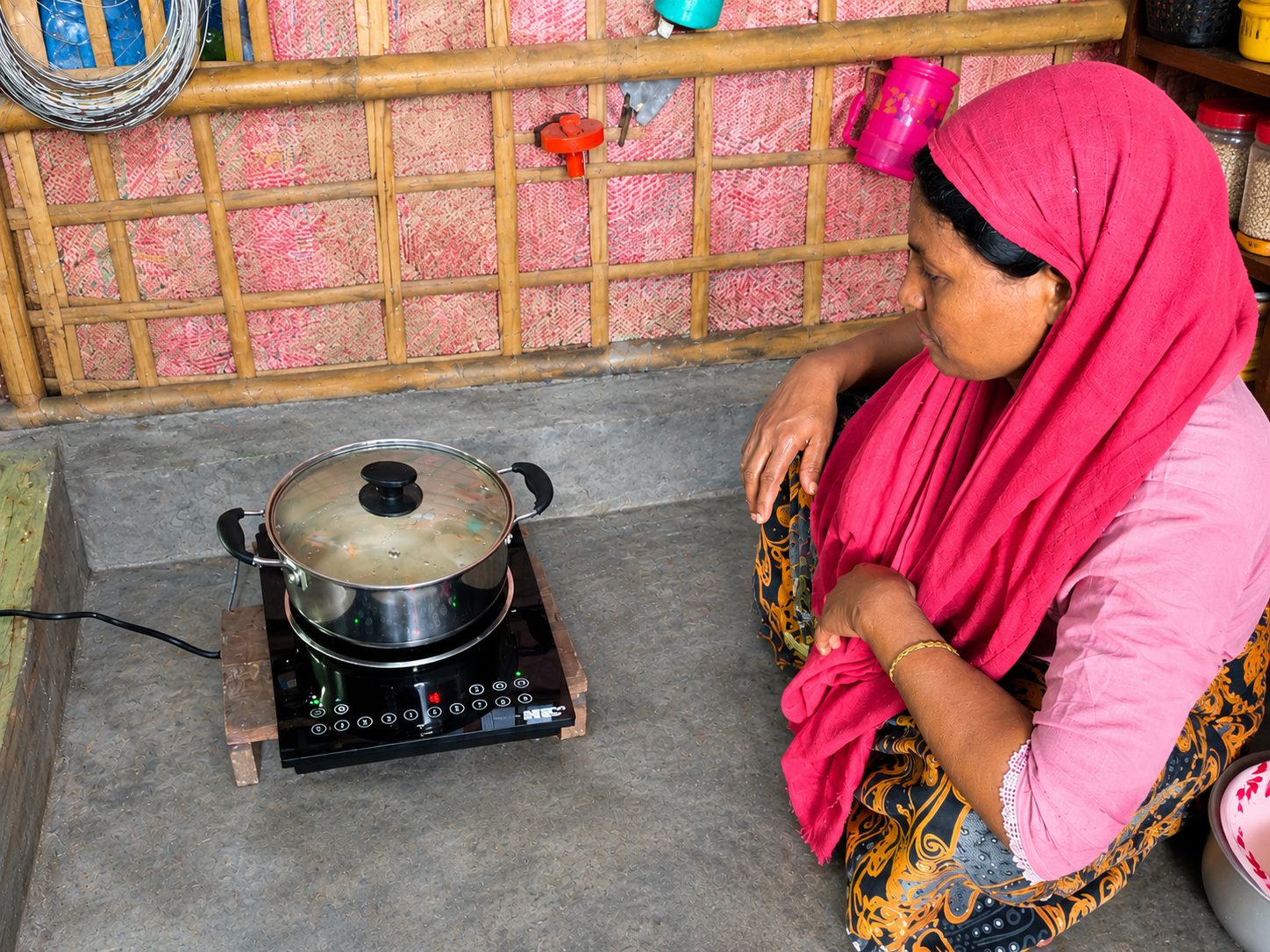
In the off-grid refugee settlements of Ukhiya, Cox's Bazar, households face complex energy challenges without access to the national electricity grid. While LPG is distributed across the camps, limited monthly rations force many families to supplement their cooking with collected biomass to prepare daily, long-boiling staples like rice, lentils (dal) and traditional curries.
To introduce a sustainable zero-emission alternative, ATEC and the NGO Forum for Public Health are deploying autonomous off-grid solar eCooking systems to 100 refugee households.
This initiative is part of the Transforming Humanitarian Energy Access (THEA) project, led by Prosper Global and the Global Platform for Action (GPA), funded by UK Aid (FCDO) through the Modern Energy Cooking Services (MECS) programme.
Each family receives two high-efficiency 500W+ solar panels, an EcoFlow E2000 power station (2048Wh capacity), and an ATEC single-burner induction cookstove. The solar panels generate Direct Current (DC) power stored in the EcoFlow battery unit and later converted to Alternating Current (AC) to power the high-efficiency cookstove.
Each stove has an embedded IoT SIM card that feeds real-time data into ATEC’s dMRV cloud platform, enabling the team to monitor daily energy consumption, track household usage patterns via a centralised live dashboard, and independently verify carbon reductions. This transparent data infrastructure establishes a proven, data-verified operational model that can later be leveraged to scale clean eCooking initiatives across complex humanitarian settings in Bangladesh and beyond.
During a recent field visit to Ukhiya, the team witnessed firsthand the sense of relief and satisfaction of bringing clean energy into these homes. Replacing wood with an induction cookstove does far more than shorten cooking hours, it restores comfort, safety and everyday peace of mind to mothers and their families.
Sitting inside her home, enjoying a cooler, smoke-free room, one refugee beneficiary reflected on the change:
"I did not even think that cooking could ever be this easy. I can even lie down while resting near this stove. There is no smoke, no fire hazard, and no eye irritation. It is so simple and safe that now even my son can cook for our family."
Beyond the off-grid refugee camps, this initiative extends into the surrounding host community of Ukhiya, Cox’s Bazar. An additional 200 grid-connected households are receiving ATEC eCook induction stoves, ensuring that both refugee families and their host neighbours benefit from the transition to electric cooking.
Whether deploying off-grid solar-plus-storage or grid-connected induction stoves, this project proves that high-tier clean energy solutions can scale in both complex humanitarian settings and surrounding host communities. ATEC is proud to be a part of an initiative that prioritises human well-being while building a future where clean, safe cooking technology is accessible to communities tha needs it most.